1 ноября 2025
1961: Bay of Pigs, 2025: Venezuela. The psychology of history repeating
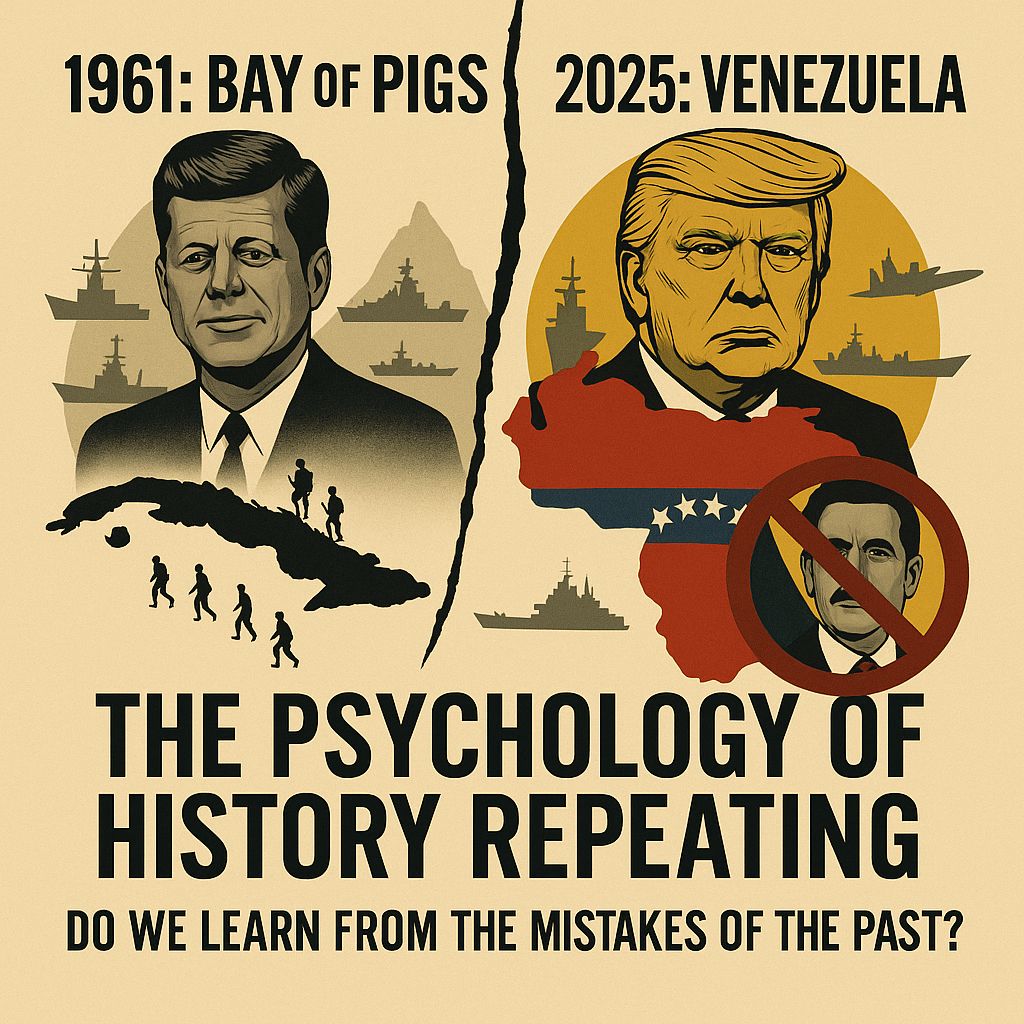
Spiral dynamics of history: we return to similar situations, but on a new turn of the spiral - with new technologies and new capabilities. Each turn offers a chance either to learn from past mistakes or to repeat them with even greater consequences. Today we are witnessing yet another such turn.
In October 2025, tensions in the Caribbean are mounting alarmingly. The Trump administration has massed unprecedented military power off Venezuela’s coast: 10 warships (including a nuclear-powered submarine), F-35 fighters, B-52 bombers, and more than 10,000 troops. Officially, the mission targets drug trafficking; unofficially, it aims at regime change against Nicolás Maduro.
The situation bears a striking psychological resemblance to events 64 years ago—the 1961 Bay of Pigs operation. A psychological reading of these parallels can tell us a great deal about how decisions are made in political conflicts.
Psychological anatomy of two conflicts
- Groupthink as the engine of disasterBay of Pigs (1961): President Kennedy and his advisers fell into the classic trap of groupthink. In the pursuit of consensus and reluctance to confront group leaders, critical scrutiny of the invasion plan was suppressed. Advisers overestimated the capabilities of Cuban émigrés in “Brigade 2506” and catastrophically underestimated the Cuban public’s resolve to defend the revolution.Venezuela (2025): A similar pattern appears around Trump. Despite internal resistance from Pentagon lawyers and the resignation of Admiral Holsey (then head of U.S. Southern Command), the administration continues toward military intervention. Defense Secretary Pete Hegseth removed Holsey precisely because he was not acting “quickly and aggressively enough” against drug trafficking- that is, he deviated from the group consensus favoring harsher measures.
- Cognitive biases and distorted attributionBoth operations display the classic attribution error: the tendency to explain an opponent’s behavior by their inherent traits (dictatorship, criminality) while ignoring situational context.1961: Castro and his supporters were seen solely as a “communist threat,” with no regard for the Cuban Revolution’s historical context or its popular support.2025: Maduro is portrayed only as the head of the “Cartel de los Soles,” though the conflict has far deeper political and economic roots. The U.S. placed a $50 million bounty on him—demonizing the leader of another state.
- “Us vs. Them” categorization and conformityBoth conflicts deploy a powerful psychological schema of ingroup favoritism and outgroup hostility.Bay of Pigs: The clash was framed as the “free world” versus “communist expansion,” justifying virtually any action against “them.”Venezuela: The rhetoric is similar—“a fight against narco-terrorism and dictatorship.” Trump has said the U.S. “controls the sea very well” and is now considering “ground operations,” creating a psychological warrant for escalation.
- Conformity under pressure1961: Members of Congress and Kennedy’s advisers stayed silent under party discipline and a Cold War consensus.2025: Senator Rand Paul has unsuccessfully tried to force the administration to seek congressional authorization for strikes. Congress received only a general briefing without details, while most politicians remain quiet, afraid of appearing “soft on drugs” or “pro-Maduro.”
- Overestimation of one’s own capabilitiesBay of Pigs: The CIA forecast a swift victory, extrapolating from Guatemala in 1954. Reality was harsher: within 72 hours, 114 invaders were killed and more than 1,100 captured.Venezuela: The Trump administration believes strikes on drug networks will automatically spark an uprising against Maduro or a coup. One source told the Miami Herald, “Maduro will soon find himself trapped… more than one general is ready to seize him.” Yet the Venezuelan military remains loyal, and Maduro has mobilized 8 million militia reservists.
- Ignoring the lessons of history
The most striking psychological feature of 2025 is the near-total disregard for 1961’s lessons.What followed the Bay of Pigs:
• Castro consolidated power.
• Cuba tightened integration with the USSR.
• The world was brought to the brink of nuclear war (the 1962 Cuban Missile Crisis).
• U.S. prestige was seriously damaged.What could follow in 2025:
• Maduro consolidates power under the banner of resisting “American imperialism.”• Latin American states (including Colombia) speak out against intervention.
• A protracted guerrilla conflict in the region becomes possible.
• Further escalation with Russia and China, both supporters of Venezuela.
Emotions as the fuel of escalationIn both cases, emotions - fear, anger, and the thirst for retribution—play a decisive role.
In 1961, it was fear of communist expansion and anger over the loss of U.S. influence in Cuba.
In 2025, it is fear of the fentanyl crisis in the U.S. (even though Venezuela is not the primary source; most fentanyl comes from Mexico) and anger over alleged electoral fraud in Venezuela. Research shows that “emotionally charged debate intensifies polarization,” leading to “radicalization of views and polarization of opinion.”
Psychological barriers to resolutionBoth conflicts exhibit classic psychological roadblocks:
- Mistrust: After years of sanctions and regime-change efforts, Venezuelan authorities doubt the sincerity of any U.S. intentions.
- Loss aversion: Both sides fear appearing weak if they compromise.
- Status-quo bias: The U.S. will not acknowledge its role in regional destabilization; Venezuela will not acknowledge its democratic shortcomings.
Conclusions: Can the cycle be broken?
Psychological analysis suggests we face not just a repetition of history, but a recurrence of decision-making patterns.
Key lessons:
- Groupthink is deadly in foreign policy. We need mechanisms that foster critical scrutiny and diversity of views.
- Demonizing the opponent always oversimplifies reality and leads to catastrophic misjudgments.
- Emotional escalation in media and politics reduces willingness to compromise and to reason.
- Ignoring historical experience is not accidental but psychological: people are prone to believe “this time is different.”
- “Us vs. them” categorization automatically triggers aggressive scripts and blocks diplomatic solutions.
Sadly, history shows that understanding these mechanisms does not guarantee we can overcome them. Human psychology often overpowers rational analysis. But recognizing these patterns is the first step toward breaking them.
Time will tell. Psychology warns, however, that without conscious work to overcome these cognitive biases and emotional reflexes, history is likely to repeat—first as tragedy, then as farce.